
Choosing a crypto trading platform can be difficult. Hundreds of exchanges and brokers offer Bitcoin, Ethereum, stablecoins, altcoins, futures, staking and other services, often with very different fees and security models.
Platforms such as Binance, Coinbase, Kraken, OKX and Bybit are internationally known, but that doesn’t mean every platform is equally suitable—or even offers the same services—in every country.
The best crypto exchange isn’t necessarily the one with the most cryptocurrencies or lowest advertised fees. Security, regulation, liquidity, total trading costs and withdrawal options should all be considered.
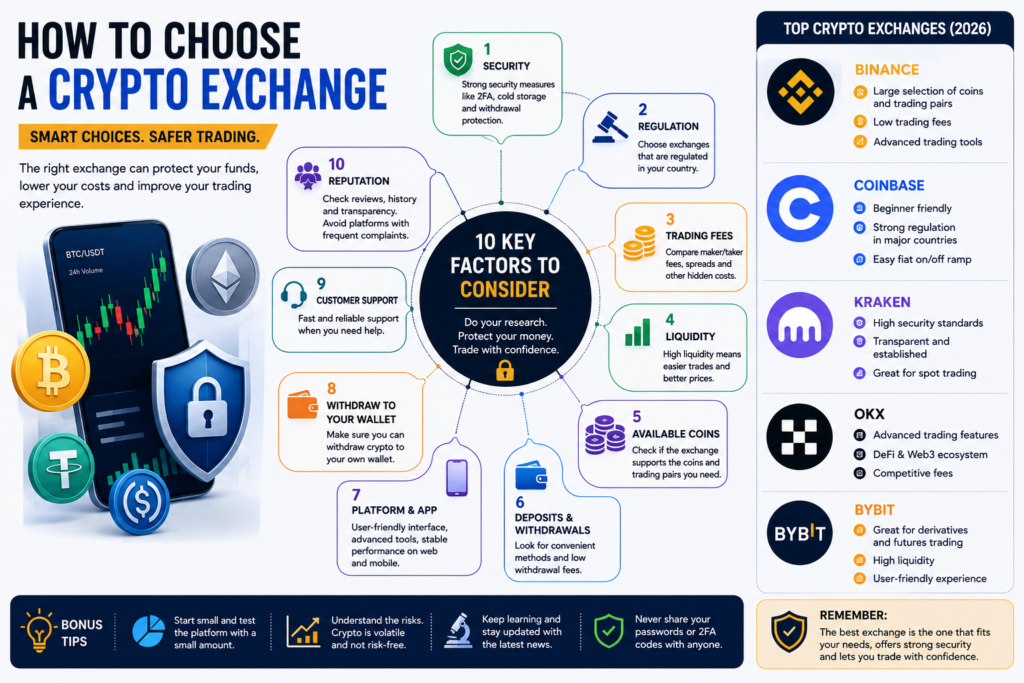
Crypto Broker vs Crypto Exchange: What’s the Difference?
Although the terms are sometimes used interchangeably, there can be important differences.
A crypto exchange provides a marketplace where buyers and sellers trade digital assets. The platform typically matches orders through an order book.
A crypto broker generally simplifies the transaction by providing users with a quoted buying or selling price.
For beginners, brokers can sometimes provide a simpler experience. More active traders may prefer exchanges because of their order books, advanced order types and potentially lower trading costs.
Some large platforms effectively combine characteristics of both models.
1. Security Should Come First
Before comparing trading fees or the number of available cryptocurrencies, investigate how the platform protects customer accounts and assets.
Important security features can include:
- Two-factor authentication (2FA)
- Withdrawal confirmations
- Anti-phishing protections
- Device management
- Cold-storage practices
- Address whitelisting
- Security notifications
You should also research the platform’s history.
Has it suffered major security incidents? How did it respond? Were customers affected? What changes were made afterward?
No centralized exchange should be considered completely immune to operational or cybersecurity risks.
2. Check Regulation in Your Country
Crypto regulation varies dramatically around the world.
A platform operating legally in one jurisdiction may have restrictions in another. Even when the same exchange operates in multiple countries, the legal entity providing your account can differ.
This matters particularly for an international audience spanning countries such as India, Nigeria, Kenya, Vietnam and other emerging markets.
Before opening an account, determine:
Who operates the platform in your country?
Is registration or authorization required locally?
Which services are legally available?
Are derivatives or leveraged products restricted?
Don’t assume that because you can access an exchange’s website, every service advertised globally is necessarily available or authorized where you live.
3. Compare Trading Fees
Crypto exchanges commonly use a maker/taker fee model.
A maker generally places an order that adds liquidity to the order book.
A taker executes against existing liquidity.
The exchange may charge different fees for each.
For example, imagine:
Maker fee: 0.10%
Taker fee: 0.10%
A $1,000 transaction at a 0.10% trading fee would represent $1 in trading fees for that transaction.
But trading fees aren’t the only cost.
4. Look Beyond the Headline Fee
Your real cost can include:
- Maker/taker fees
- Bid-ask spread
- Fiat deposit fees
- Fiat withdrawal fees
- Blockchain withdrawal fees
- Currency conversion
- Card processing fees
- Futures fees
- Borrowing costs
- Funding rates
This means an exchange advertising extremely low trading fees can still be expensive depending on how you deposit, trade and withdraw.
For frequent traders, relatively small differences can accumulate quickly.
5. Check Liquidity
Liquidity is one of the most important—and frequently overlooked—characteristics of a crypto exchange.
High liquidity generally makes it easier to buy or sell an asset without dramatically affecting its price.
Suppose you want to purchase $100 of Bitcoin. Liquidity probably won’t be a major concern on a large exchange.
But imagine trying to execute a much larger transaction in a small altcoin with little trading activity.
The difference between the expected price and actual execution price can become significant.
This is known as slippage.
For active traders, liquidity can therefore be just as important as advertised fees.
6. Check Which Cryptocurrencies Are Available
Bitcoin and Ethereum are available on most major crypto platforms.
Beyond those assets, availability can differ substantially.
Depending on the exchange, you may find:
- Bitcoin (BTC)
- Ethereum (ETH)
- Stablecoins
- Large-cap altcoins
- Smaller altcoins
- DeFi tokens
- Other digital assets
More cryptocurrencies don’t automatically make an exchange better.
Platforms listing highly speculative assets can expose inexperienced traders to considerably greater volatility and liquidity risk.
Choose based on the assets you actually intend to trade.
7. Compare Spot and Futures Trading
Crypto platforms can offer several different markets.
Spot Trading
You buy or sell cryptocurrency at the current market price and generally receive the corresponding crypto balance in your exchange account.
For example:
USDT → BTC
Futures Trading
Futures and perpetual contracts allow traders to speculate on price movements without necessarily purchasing the underlying cryptocurrency.
These products frequently involve leverage.
That substantially changes the risk.
A relatively small price movement can create disproportionately large gains or losses when leverage is involved, and positions can potentially be liquidated.
Beginners should understand spot trading thoroughly before considering leveraged derivatives.
8. Can You Withdraw Crypto to Your Own Wallet?
This is an important distinction between platforms.
If you purchase Bitcoin, can you send that BTC to a blockchain address that you control?
For users who want self-custody, the answer matters enormously.
Check:
- Supported blockchain networks
- Minimum withdrawal amounts
- Withdrawal fees
- Processing procedures
- Withdrawal limits
- Address whitelisting
- Security confirmations
A platform designed primarily for price exposure may work differently from a cryptocurrency exchange designed to allow blockchain deposits and withdrawals.
9. Compare Deposit and Withdrawal Methods
Payment options vary considerably by country.
Depending on your location and platform, options might include:
- Bank transfers
- Debit or credit cards
- Local payment systems
- Crypto deposits
- Third-party payment providers
- P2P marketplaces
Don’t evaluate only how easy it is to deposit.
Investigate how you will withdraw your money before depositing it.
Look at withdrawal fees, supported currencies, processing procedures and limits.
10. Evaluate the Mobile App
A large proportion of crypto trading happens through smartphones.
A good crypto app should make essential information easy to understand.
Look for:
- Portfolio balance
- Spot trading
- Order history
- Charts
- Price alerts
- Deposits
- Withdrawals
- Security controls
- Open orders
Advanced traders may additionally want sophisticated charting, API access and multiple order types.
Beginners usually benefit from a simpler interface.
11. Compare Order Types
Basic exchanges typically provide:
Market orders — execute at the best available market price.
Limit orders — execute at a specified price or better.
More sophisticated platforms may provide stop orders, conditional orders and other advanced functionality.
Understanding order types can help traders control how transactions are executed.
Never use an order type you don’t understand simply because the platform makes it available.
12. Consider Stablecoin Availability
Stablecoins play an important role in crypto markets.
Many international exchanges use stablecoins such as USDT or USDC as trading pairs.
For example:
BTC/USDT
ETH/USDT
SOL/USDT
This can make it easier to move between cryptocurrency positions without immediately converting funds back into a local fiat currency.
However, stablecoins have their own issuer, regulatory, reserve and depegging risks. They shouldn’t automatically be treated as equivalent to money held in a traditional insured bank account.
13. Look at Proof of Reserves—but Understand Its Limitations
Following major failures in the cryptocurrency industry, some centralized exchanges began publishing proof-of-reserves information.
This can provide additional transparency about certain assets controlled by an exchange.
However, proof of reserves alone doesn’t necessarily provide a complete picture of an exchange’s financial health.
Assets are only one side of a balance sheet.
Users should also consider liabilities, corporate structure, custody arrangements and the quality of any independent verification.
Proof of reserves is therefore useful information—not a guarantee of solvency.
14. Compare Customer Support
Crypto markets operate 24 hours a day, seven days a week.
Customer support can therefore be particularly important.
Look for:
- 24/7 support
- Live chat
- Email support
- Help center
- Local-language assistance
- Account recovery procedures
Pay particular attention to how the platform handles problems involving deposits, withdrawals and account access.
15. Compare the Major Platforms
There is no universal winner, but large platforms tend to appeal to different types of users.
| Platform | Common reason users consider it |
|---|---|
| Binance | Large trading ecosystem and broad market selection |
| Coinbase | Simpler interface and strong presence in regulated markets |
| Kraken | Security-oriented reputation and established trading platform |
| OKX | Advanced trading ecosystem and Web3 integration |
| Bybit | Trading-focused platform and advanced market tools |
This comparison shouldn’t be interpreted as a recommendation to use any particular exchange. Availability, products, fees and regulatory status vary by jurisdiction and can change over time.
16. Centralized Exchange vs Self-Custody
When you leave cryptocurrency on a centralized exchange, the platform generally controls the private keys associated with the underlying wallet infrastructure.
With self-custody, you control the private keys.
Both approaches involve different risks.
Centralized exchange
Advantages:
Convenient trading, password recovery mechanisms, fiat integration and relatively simple user experience.
Risks:
Counterparty risk, platform failure, account restrictions and cybersecurity incidents.
Self-custody
Advantages:
Direct control over your crypto assets.
Risks:
You become responsible for protecting private keys or recovery phrases. Losing them can mean permanently losing access to your assets.
For some users, a combination can make sense: using an exchange for trading while keeping longer-term holdings in appropriately secured self-custody.
How to Choose the Best Crypto Exchange
A simple selection process is:
1. Regulation → Is the platform permitted to provide the relevant service in your country?
2. Security → How are accounts and assets protected?
3. Liquidity → Can trades be executed efficiently?
4. Fees → What is the total cost, not just the advertised trading fee?
5. Assets → Does it offer the cryptocurrencies you actually need?
6. Deposits and withdrawals → Can you move fiat and crypto conveniently?
7. Platform → Is the app suitable for your experience level?
8. Custody → Can you withdraw your cryptocurrency to your own wallet?
9. Support → Can you get help when something goes wrong?
Final Thoughts
The question shouldn’t simply be:
«Which crypto exchange has the lowest fees?»
A better question is:
«Which platform gives me the best combination of security, regulation, liquidity, costs and control over my assets?»
For a beginner, security and ease of use may matter more than advanced trading features.
For an active trader, liquidity, execution and fees become increasingly important.
For a long-term cryptocurrency holder, the ability to withdraw assets into self-custody may be one of the most important considerations.
And because cryptocurrency regulation differs substantially between countries, always verify the current legal and regulatory status of a platform in your jurisdiction before depositing money.
Disclaimer: This article is for educational purposes only and does not constitute financial or investment advice. Cryptocurrency markets are highly volatile, and trading—particularly with leverage—can result in substantial losses.