
Choosing a forex trading platform is about much more than finding the broker advertising the lowest spread. Regulation, trading costs, platform quality, withdrawals, available currency pairs and ease of use can all affect your trading experience.
This is particularly important for international traders because a broker available in one country may operate under a different regulatory entity—or may not be available at all—in another.
Below, we compare some of the best-known forex trading platforms and explain what you should look for before opening an account.
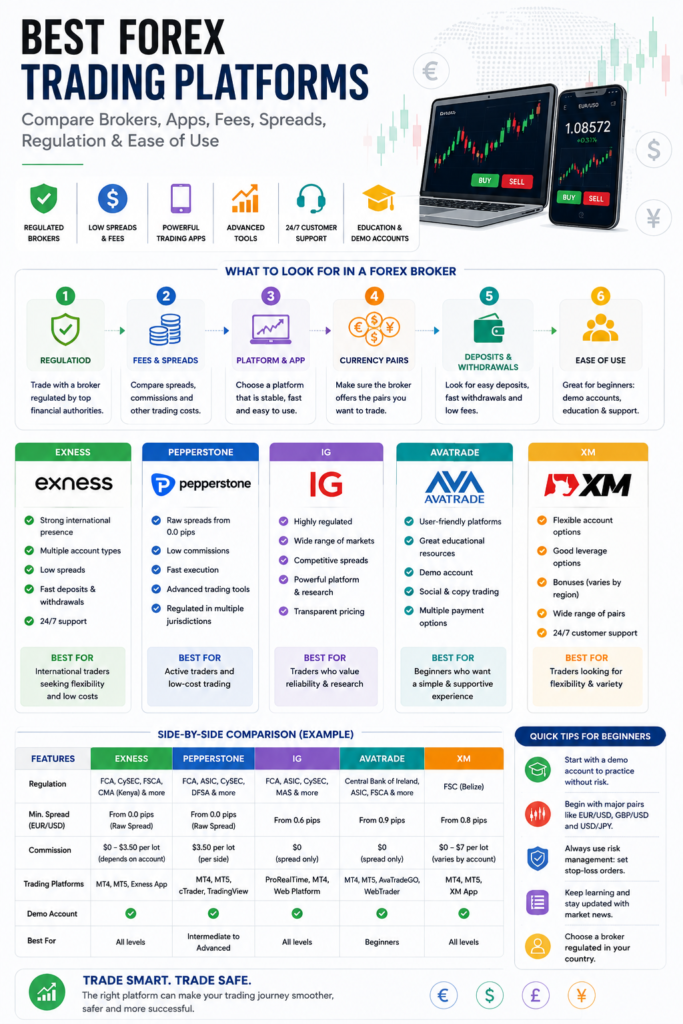
What Makes a Good Forex Trading Platform?
A good forex broker should perform well in six areas:
- Regulation — Who regulates the broker in your country?
- Spreads and commissions — What does each trade actually cost?
- Trading platform — Is the app or platform reliable and easy to use?
- Currency pairs — Does it offer the markets you want to trade?
- Deposits and withdrawals — Are convenient local payment methods available?
- Beginner experience — Are demo accounts, education and risk-management tools available?
The last point is particularly important for new traders. A platform with hundreds of advanced features isn’t necessarily better if you don’t understand how to use them.
Best Forex Trading Platforms to Consider
For an international comparison, useful brokers to examine include Exness, Pepperstone, IG, AvaTrade and XM.
Availability and regulatory protection vary by country, so these should be treated as platforms to compare rather than a universal ranking.
| Broker | Main Strength | Costs/Spreads | Beginner Friendliness |
|---|---|---|---|
| Exness | International accessibility | Competitive, account-dependent | ⭐⭐⭐⭐⭐ |
| Pepperstone | Low-cost active trading | Raw spreads available | ⭐⭐⭐⭐ |
| IG | Established platform & regulation | Competitive major-pair spreads | ⭐⭐⭐⭐ |
| AvaTrade | Beginner-friendly experience | Spread-based pricing | ⭐⭐⭐⭐⭐ |
| XM | Accessible international offering | Account-dependent | ⭐⭐⭐⭐ |
Independent testing in 2026 also places several of these firms among notable beginner choices, although spreads and minimum deposits vary substantially by broker and account type. (ForexBrokers.com)
1. Exness — Strong International Option
Exness is particularly relevant to traders in emerging and international markets.
It provides forex trading through its own mobile experience as well as established trading platforms, and offers different account structures depending on the trader’s experience and preferred pricing model.
Why traders may consider Exness
- Mobile forex trading
- Demo trading
- Multiple account types
- Major and minor currency pairs
- 24/7 support
- Multiple international regulatory licenses
Exness states that spreads vary according to market conditions and publishes average spreads by instrument and account type. It also holds licenses from regulators including the FCA, CySEC, FSCA and Kenya’s CMA, among others. (Exness)
Best suited for: traders wanting an internationally oriented broker with relatively accessible account options.
2. Pepperstone — Strong for Low-Cost Trading
Pepperstone is particularly attractive to traders who care about spreads and execution costs.
Its Razor account uses a model combining very tight raw spreads with commissions.
Pepperstone currently advertises raw spreads starting from 0.0 pips on Razor accounts, although actual spreads are variable and commissions need to be considered when calculating total trading cost. (Pepperstone)
This distinction matters.
A broker advertising:
0.0 pip spread
doesn’t necessarily mean:
zero-cost trading.
The commission must be included.
Pepperstone is also particularly interesting for the African portion of an international audience because Pepperstone Markets Kenya is specifically licensed by Kenya’s Capital Markets Authority. (Autoridad de Mercados de Capitales)
Best suited for: active traders who prioritize tight spreads and more advanced trading conditions.
3. IG — Strong Established Forex Platform
IG is one of the more established names in online trading.
One advantage is transparency around forex pricing.
For example, IG currently lists minimum spreads such as 0.6 pips for EUR/USD and 0.7 for USD/JPY on the referenced MetaTrader product specification, although actual spreads are variable and can widen during periods of low liquidity or important economic announcements. (IG)
That last point is crucial when comparing brokers.
Never compare brokers using only their advertised minimum spread.
Compare:
Typical/average spread + commission + financing costs
whenever the information is available.
Best suited for: traders who prioritize an established trading ecosystem and detailed market information.
4. AvaTrade — Strong Beginner Experience
AvaTrade is another international broker worth comparing, particularly for beginners.
Independent testing by ForexBrokers.com ranks AvaTrade among its leading beginner-oriented forex brokers for 2026, citing its accessible platform experience, educational resources and demo-account capabilities. Its reported average EUR/USD spread in that comparison was approximately 0.93 pips, though actual pricing can vary. (ForexBrokers.com)
A demo account is particularly valuable for beginners because it allows them to learn:
- How currency pairs work
- How orders are placed
- How stop-loss orders work
- How position sizes affect risk
- How leverage affects gains and losses
without immediately risking real capital.
Best suited for: beginners who prioritize learning and usability.
5. XM — Accessible International Alternative
XM is another globally oriented broker with different account structures and forex products.
XM Global Limited states that it is regulated by the Financial Services Commission of Belize under license number 8557558. The company also explicitly notes that availability depends on jurisdiction and that its services aren’t offered everywhere. (XM)
That illustrates an important principle when comparing international brokers:
The broker’s brand isn’t enough.
You need to determine which legal entity will actually hold your account.
Best suited for: international traders looking for another established multi-market alternative.
Understanding Forex Spreads
The spread is the difference between the bid and ask price of a currency pair.
Imagine EUR/USD showing:
Bid: 1.1000
Ask: 1.1001
The difference is 1 pip.
That spread effectively represents part of the cost of entering the trade.
This is why active traders care so much about spreads.
Someone making two trades per month may barely notice a small spread difference.
Someone making hundreds of trades can.
Raw Spread vs Standard Accounts
Many brokers offer two basic pricing approaches.
Standard account
Usually:
Wider spread + no separate trading commission
This is simpler for beginners.
Raw spread account
Usually:
Very tight spread + explicit commission
This can potentially be more attractive for high-frequency or active traders.
Neither model is automatically cheaper.
You need to calculate the total trading cost.
Regulation Is More Important Than a Tiny Spread Difference
Suppose Broker A offers:
EUR/USD from 0.8 pips
while Broker B offers:
EUR/USD from 0.6 pips.
The difference shouldn’t automatically determine your decision.
You should first ask:
Who regulates each broker?
This becomes particularly important for an international audience.
For example, Kenya’s CMA maintains an official list of licensed online forex brokers. Its current list includes locally licensed entities associated with Pepperstone, Exness, HFM, FP Markets, IC Markets, AvaTrade and others. (Autoridad de Mercados de Capitales)
A broker’s regulatory situation can therefore differ significantly from one country to another.
What About India?
India requires particular attention because forex regulation differs from many international markets.
A trader shouldn’t assume that because an international forex platform accepts registrations or appears in Google results, every product it offers is legally authorized for residents of that jurisdiction.
The same principle applies elsewhere:
Check your local regulator before funding an account.
This is more reliable than relying on advertisements, influencers or broker-review websites.
Trading Apps: What Should You Look For?
A good forex mobile app should make it easy to:
- Monitor currency pairs
- Open and close positions
- Set stop-loss and take-profit orders
- View charts
- Check account margin
- Review transaction history
- Receive price alerts
- Deposit and withdraw funds
More features don’t necessarily mean a better app.
For beginners, clarity can be more valuable than complexity.
Forex Platform Comparison
For a simplified comparison:
Exness → international accessibility
Pepperstone → spreads and active trading
IG → established trading ecosystem
AvaTrade → beginner experience
XM → international alternative
But there is no single «best forex broker» for every country.
The correct question is:
Which regulated broker offers the best combination of costs, platform and services where I live?
How to Choose a Forex Broker
Before depositing money, check:
Regulation → Costs → Platform → Currency pairs → Deposits/withdrawals → Support
In that order.
Don’t choose a broker simply because it offers extremely high leverage, bonuses or claims of ultra-low spreads.
And don’t underestimate withdrawal conditions. Being able to deposit money easily isn’t enough; you should understand how withdrawals work before funding the account.
Final Verdict
For beginners, Exness and AvaTrade stand out for accessibility and relatively approachable trading experiences.
For traders who become more cost-sensitive or active, Pepperstone becomes particularly interesting because of its raw-spread pricing structure.
IG is attractive for traders who value an established platform and detailed pricing information, while XM provides another internationally available alternative.
However, geographic location changes the ranking.
A platform that makes sense for a trader in Kenya may not be appropriate for someone in India, Nigeria, Vietnam or another country.
Therefore, the best forex trading platform isn’t simply the broker with the lowest advertised spread.
It is the platform that combines:
appropriate local regulation + competitive total trading costs + reliable software + convenient payments + suitable trading tools.
Risk warning: Forex and CFD trading can result in substantial losses, particularly when leverage is used. This article is educational and does not constitute investment advice. Broker availability, fees, spreads and regulatory status can change; verify current information with the broker and your local financial regulator before opening an account.