
Travel credit cards can make flights, hotels and everyday purchases more rewarding. Depending on the card, travelers can earn airline miles, hotel points or cashback while receiving additional benefits such as airport lounge access, travel insurance and reduced foreign transaction fees.
But the best travel credit card isn’t necessarily the card offering the biggest welcome bonus. The right choice depends on how often you travel, where you spend money, which airlines or hotels you use and how much the card costs to keep each year.
This guide explains what to compare when choosing a travel credit card in 2026.
What Is a Travel Credit Card?
A travel credit card is a credit card that provides rewards or benefits particularly useful for travelers.
Depending on the card, benefits may include:
- Airline miles
- Hotel points
- Cashback
- Airport lounge access
- Travel insurance
- Discounts on flights or hotels
- Free or discounted checked baggage
- Priority boarding
- Foreign transaction fee savings
- Rewards on international spending
Travel cards generally fall into three broad categories.
General Travel Rewards Cards
These cards earn flexible points that can often be redeemed for different types of travel.
They can be useful if you don’t consistently use one airline or hotel chain.
Airline Credit Cards
These cards are associated with a particular airline or loyalty program.
Benefits can include miles, priority boarding, baggage allowances or airline-specific discounts.
They make the most sense when you frequently use the same airline.
Hotel Credit Cards
Hotel cards earn rewards associated with a hotel loyalty program.
Depending on the product, benefits may include free-night awards, status advantages or additional points for hotel stays.
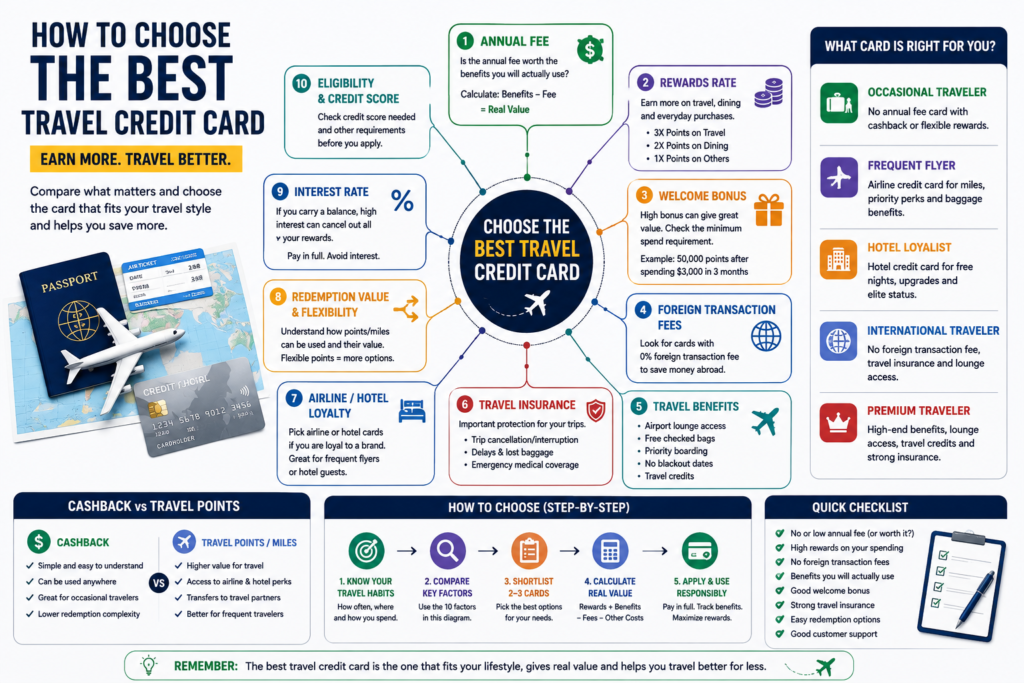
What Should You Compare?
When comparing travel credit cards, focus on the total value you are likely to receive, not just the advertised number of reward points.
Seven factors deserve particular attention:
Annual fee → rewards rate → welcome bonus → redemption value → foreign transaction fees → travel benefits → eligibility requirements.
Let’s examine each one.
1. Annual Fee
Some travel cards have no annual fee, while premium cards can charge substantial yearly fees.
A higher fee isn’t necessarily bad.
Imagine one card costs $100 per year but provides benefits you genuinely use worth more than $300.
That could potentially be better value than a free card providing almost nothing useful.
The relevant calculation is:
Annual benefits you actually use − annual fee = approximate net value
The key phrase is actually use.
A $200 airport lounge benefit isn’t worth $200 to someone who never visits airport lounges.
2. Travel Rewards
Travel cards can reward purchases differently.
For example, a hypothetical card might offer:
3× points on travel
2× points on restaurants
1× point on other purchases
Another might provide straightforward cashback.
Don’t automatically assume that earning more «points» means receiving more value.
Points from different programs can have very different redemption values.
3. Welcome Bonuses
Welcome bonuses are one of the biggest attractions of travel cards.
A typical structure might look like:
Earn 50,000 points after spending $3,000 within your first three months.
The bonus can be valuable, but there are two things to consider.
First, determine what those points are actually worth when redeemed.
Second, never increase spending unnecessarily simply to obtain a bonus.
A reward loses much of its value if earning it causes you to purchase things you otherwise wouldn’t have bought.
4. Foreign Transaction Fees
This is particularly important for international travelers.
Some credit cards charge an additional percentage when purchases are processed in a foreign currency or otherwise qualify as foreign transactions.
Suppose a card charges a hypothetical 3% foreign transaction fee.
Spending the equivalent of $2,000 abroad could result in approximately:
$2,000 × 3% = $60
in additional fees.
Frequent international travelers should therefore pay particular attention to cards with no foreign transaction fee, where available.
5. Airport Lounge Access
Premium travel cards sometimes include airport lounge benefits.
Depending on the card, this might involve:
- Proprietary airport lounges
- Airline lounges
- Third-party lounge networks
- A limited number of complimentary visits
This benefit can be particularly valuable for frequent travelers.
But check the conditions carefully.
«Lounge access» doesn’t always mean unlimited free access to every lounge.
Guest policies and participating airports can also vary.
6. Travel Insurance
Some credit cards provide travel-related insurance when eligible expenses are paid using the card.
Coverage may include certain circumstances involving:
- Trip cancellation
- Trip interruption
- Travel delays
- Lost or delayed baggage
- Rental vehicles
- Accidents during travel
Insurance terms, exclusions and coverage limits can differ substantially.
Never assume that simply owning the card means every trip or event is automatically covered.
Read the actual insurance documentation.
7. Airline Miles
If you frequently fly with one airline or alliance, an airline credit card can potentially provide considerable value.
Possible benefits include:
Miles for purchases
Additional miles on airline spending
Priority boarding
Baggage benefits
Companion benefits
Discounts on onboard purchases
But airline-specific cards also reduce flexibility.
If another airline suddenly offers a much cheaper or more convenient route, flexible rewards may be more useful than miles locked into one loyalty ecosystem.
8. Hotel Rewards
Frequent hotel guests face a similar decision.
Hotel credit cards can provide:
- Points on stays
- Free-night certificates
- Elite status
- Room upgrades when available
- Late checkout
- Hotel credits
These benefits become more valuable when you regularly stay with the same hotel group.
Occasional travelers may benefit more from flexible rewards.
9. Cashback vs Miles: Which Is Better for Travel?
Cashback has one enormous advantage:
simplicity.
If you earn $100 cashback, understanding its value is easy.
Travel points can potentially provide greater value in certain circumstances, but redemption systems can be more complicated.
| Cashback | Travel Points/Miles |
|---|---|
| Easy to understand | Potentially higher travel value |
| Flexible | Can offer airline/hotel benefits |
| Simple redemption | Redemption values can vary |
| Usually fewer restrictions | May involve program restrictions |
| Good for occasional travelers | Often better for frequent travelers |
Neither system is universally superior.
10. Flexible Points vs Airline Miles
Flexible points can be especially attractive to international travelers.
Depending on the card program, points may potentially be transferred to different airline or hotel partners.
This provides more options.
Instead of earning rewards exclusively with Airline A, you might be able to choose among several participating travel partners when you’re ready to book.
However, transfer ratios and partners can change.
Never accumulate large amounts of points assuming today’s redemption options will remain unchanged forever.
11. Consider International Acceptance
A travel card isn’t particularly useful if merchants at your destination frequently don’t accept its payment network.
Before traveling internationally, consider the acceptance of the card’s network in your destination.
Carrying a backup payment method can also be sensible.
Travelers shouldn’t depend entirely on a single card.
12. Currency Conversion Matters
International purchases introduce another issue: exchange rates.
When paying abroad, you may sometimes be asked whether you want the transaction converted into your home currency.
This service is commonly known as dynamic currency conversion (DCC).
The apparently convenient option isn’t necessarily the cheapest.
Always examine the exchange rate and fees before accepting currency conversion at a merchant or ATM.
13. Premium vs No-Annual-Fee Travel Cards
A premium card isn’t automatically better.
No-Annual-Fee Card
Potentially better for:
- Occasional travelers
- Beginners
- People with relatively low spending
- Users primarily interested in basic rewards
Premium Travel Card
Potentially better for:
- Frequent travelers
- High travel spending
- Airport lounge users
- People who can genuinely use travel credits and insurance benefits
The more expensive card only makes sense when its additional benefits justify its additional cost.
14. Don’t Ignore Interest Rates
Rewards receive most of the advertising attention, but interest can be much more important financially.
If you carry a credit card balance and pay substantial interest, the interest cost can easily exceed the value of your miles, cashback or travel rewards.
For example, earning $20 in rewards isn’t particularly useful if carrying the purchase generates $50 in interest.
Travel rewards work best when they complement responsible credit-card use rather than encourage additional debt.
How to Choose the Best Travel Credit Card
Before applying, ask yourself:
How many times do I travel each year?
Do I travel domestically or internationally?
Do I consistently use one airline?
Do I stay with one hotel chain?
How much will I realistically spend on the card?
Will I use airport lounges?
Does the card charge foreign transaction fees?
Can I justify the annual fee?
How easily can I redeem the rewards?
Will I pay the balance in full?
Your answers will narrow the options considerably.
Best Type of Travel Card by Traveler
| Traveler | Card Type to Consider |
|---|---|
| First-time cardholder | No-annual-fee rewards card |
| Occasional traveler | Cashback or flexible rewards |
| Frequent international traveler | No foreign transaction fee + travel rewards |
| Frequent flyer | Airline or transferable-points card |
| Frequent hotel guest | Hotel rewards card |
| Premium traveler | Lounge + insurance + travel credits |
| Budget traveler | Low/no annual fee + cashback/rewards |
One Important International Consideration
There is no meaningful universal list of the «best travel credit cards» for every country.
Banks issue different cards in India, Nigeria, Kenya, Vietnam and other markets. Eligibility requirements, annual fees, rewards programs, airline partnerships and foreign transaction charges also vary.
Therefore, international travelers should compare cards available in their own country, rather than applying recommendations written for another market.
The principles for evaluating them, however, remain largely the same.
Final Thoughts
The best travel credit card isn’t necessarily the one offering the most points.
A better travel card is one whose benefits match the way you actually travel and spend.
For occasional travelers, a simple no-annual-fee cashback or rewards card may provide enough value.
Frequent international travelers may benefit more from cards offering flexible points, airport lounge access, travel protection and no foreign transaction fees.
And travelers loyal to a particular airline or hotel chain may obtain greater value from a co-branded card.
Ultimately, compare:
Rewards + travel benefits + welcome bonus − annual fee − other costs
Then choose the card that provides genuine value based on your normal spending rather than changing your spending simply to earn rewards.
Disclaimer: This article is for educational purposes only. Credit-card products, fees, rewards and eligibility requirements vary by issuer and country and can change over time. Always review the issuer’s current terms before applying.