
Owning a home without a mortgage can be an attractive financial goal. Paying off your home loan early means fewer monthly obligations, less interest paid to the lender and the security of owning your property without outstanding mortgage debt.
But using all your available savings to eliminate a home loan isn’t automatically the best financial decision.
Before making an extra payment, you need to compare your mortgage interest rate, remaining loan term, liquidity needs, other debts, investment alternatives and any prepayment charges.
Here’s how to decide.
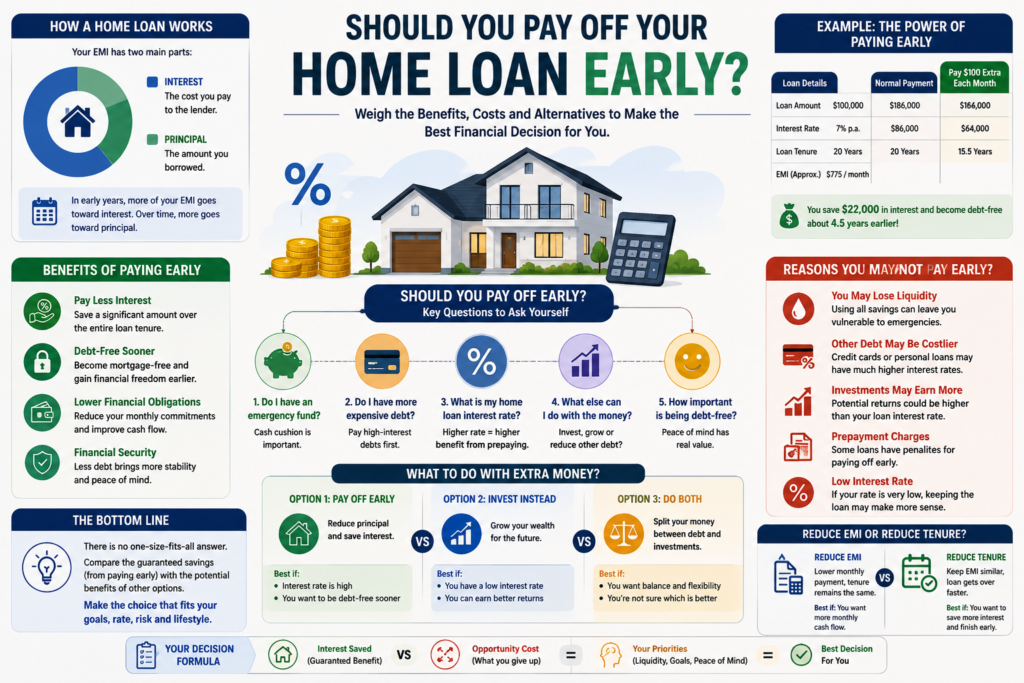
What Does Paying Off a Home Loan Early Mean?
When you take a home loan, your monthly payment normally contains two main components:
Principal — repayment of the amount borrowed.
Interest — the cost charged by the lender for lending you the money.
Depending on the loan, your payment may also incorporate or accompany other costs such as insurance, taxes or fees.
Paying the loan off early means making additional principal payments so that the outstanding balance reaches zero before the original maturity date.
You might accomplish this through:
- Small additional monthly payments
- One extra payment each year
- Periodic lump-sum payments
- Increasing your regular EMI
- Paying the entire remaining balance
The financial effect can be significant because reducing principal can also reduce the amount on which future interest is calculated.
Why Paying Early Can Save So Much Interest
Consider a simplified example.
Suppose you borrow $100,000 for 20 years at 7% annual interest, with monthly payments.
The principal-and-interest payment would be approximately:
$775 per month
Over 20 years, total payments would be approximately:
$186,000
That means roughly $86,000 would represent interest.
Now suppose you consistently pay an additional $100 per month toward principal.
The loan could be eliminated roughly 4½ years earlier, with interest savings of approximately $22,000.
The exact result depends on the loan terms, payment timing and how the lender applies additional payments, but it illustrates an important principle:
Small additional principal payments can create substantial long-term savings.
What Is EMI?
In many countries, particularly across Asian financial markets, borrowers commonly encounter the term EMI — Equated Monthly Instalment.
An EMI represents the regular payment made toward a loan.
For a standard amortizing home loan, the calculation can be expressed as:
EMI = P × r × (1+r)ⁿ ÷ [(1+r)ⁿ − 1]
Where:
P = principal borrowed
r = monthly interest rate
n = number of monthly payments
At the beginning of a long-term mortgage, a larger portion of the payment can go toward interest. As the outstanding balance falls, progressively more of the payment goes toward principal.
This is one reason why making additional principal payments earlier in the loan can have a particularly meaningful effect.
Advantages of Paying Off Your Home Loan Early
1. You Pay Less Interest
This is the most obvious benefit.
Every unit of principal eliminated early is money on which you may no longer have to pay future mortgage interest.
If your home loan carries a relatively high interest rate, the savings can become substantial.
2. You Become Debt-Free Earlier
Imagine your original mortgage ends when you’re 60.
Additional payments might move that date to 52 or 55.
That means several additional years without a monthly home-loan payment.
For many households, that can dramatically improve monthly cash flow.
3. Your Financial Obligations Decrease
Once the mortgage disappears, the money previously allocated to the EMI can be redirected toward other goals:
- Retirement
- Investments
- Education
- Business
- Emergency savings
- Travel
- Other household expenses
Your required monthly expenses also become lower.
4. You Receive a Predictable Financial Benefit
Suppose your mortgage costs 8% annually.
Paying additional principal produces a financial benefit related to avoiding future interest at that rate, subject to the precise loan structure, taxes and fees.
Unlike an investment, the interest avoided doesn’t depend on whether the stock market rises next year.
However, that doesn’t automatically mean prepayment is better than investing.
Opportunity cost matters.
Why You Might NOT Want to Pay Off Your Mortgage Early
This is where the decision becomes more interesting.
1. You Could Lose Liquidity
Imagine you have:
$30,000 in savings
and
$80,000 remaining on your mortgage.
Using the entire $30,000 as a prepayment reduces your debt substantially.
But now you may have very little cash available.
Then your car breaks down, you lose your income temporarily or an unexpected family expense appears.
Your home has more equity—but you can’t easily use home equity to buy groceries.
This is the difference between wealth and liquidity.
Before aggressively paying down a mortgage, maintaining an appropriate emergency reserve can be important.
2. Other Debt May Be More Expensive
Suppose you have:
Home loan: 7%
Personal loan: 14%
Credit card: 25%
Putting $5,000 toward a 7% mortgage while continuing to carry a 25% credit-card balance usually deserves careful reconsideration.
The higher-interest debt is costing substantially more.
A common approach is therefore to prioritize expensive consumer debt before aggressively prepaying relatively inexpensive secured debt.
3. Investing Could Potentially Produce Higher Returns
This is the classic pay mortgage vs invest question.
Imagine your mortgage costs 5%.
You have an extra $500 each month.
You could:
Option A: put $500 toward your mortgage.
or
Option B: invest $500.
If your investments ultimately generate returns greater than the effective mortgage cost, investing could produce greater wealth.
But there’s a crucial difference:
Mortgage interest avoided is relatively predictable.
Investment returns are uncertain.
A stock portfolio might average attractive returns over a long period, but it can also lose substantial value during individual years.
Therefore, comparing a guaranteed mortgage rate with an assumed investment return isn’t an apples-to-apples comparison.
Risk matters.
4. Your Mortgage May Be Very Cheap
Imagine someone obtained a long-term fixed mortgage at 3%.
Another borrower has a mortgage at 9%.
The economics of early repayment are very different.
At 9%, eliminating mortgage debt becomes much more financially attractive.
At 3%, retaining the loan and allocating surplus capital elsewhere may deserve greater consideration.
There is no universal interest-rate threshold because taxes, inflation, investment opportunities and risk tolerance differ.
5. Prepayment Penalties May Apply
Some home loans impose charges when borrowers repay part or all of the loan earlier than scheduled.
Rules differ by lender, loan type and country.
Before making a large prepayment, ask your lender:
Is there a prepayment penalty?
How much can I prepay without a charge?
Will the payment reduce principal immediately?
Will it shorten my loan term or reduce my EMI?
The answers can materially affect the calculation.
Reduce EMI or Reduce Loan Tenure?
If you make a substantial partial prepayment, some lenders may give you a choice.
Option A: Reduce the EMI
Your remaining loan lasts approximately as long, but your monthly payment decreases.
This improves monthly cash flow.
Option B: Reduce the Loan Tenure
You continue making a similar EMI but finish the mortgage earlier.
If your objective is to maximize interest savings, reducing the remaining term will generally have a stronger effect than merely lowering the EMI, assuming otherwise equivalent loan conditions.
If your priority is monthly affordability, lowering the EMI may be preferable.
Example: What Happens With a Large Prepayment?
Imagine:
Remaining mortgage: $100,000
Interest rate: 7%
Remaining term: 20 years
Your approximate principal-and-interest payment is:
$775/month
Now imagine you immediately reduce the principal by $20,000.
The remaining balance becomes:
$80,000
If the interest rate and remaining 20-year term stay the same, the corresponding payment would be approximately:
$620/month.
Alternatively, if the payment remains around $775 and the loan permits the prepayment to shorten the amortization period, the mortgage could finish considerably earlier.
This illustrates why borrowers should ask their lender exactly how a partial prepayment will modify the loan.
Early Repayment vs Investing
A useful framework is to compare several factors:
| Factor | Pay Home Loan Early | Invest Instead |
|---|---|---|
| Interest savings | Predictable | N/A |
| Potential return | Limited to avoided borrowing cost | Potentially higher |
| Risk | Relatively low | Depends on investment |
| Liquidity | Usually decreases | Can be higher, depending on asset |
| Debt reduction | Yes | No |
| Market exposure | None | Yes |
| Peace of mind | Often higher | Depends on person |
Neither side automatically wins.
The answer depends heavily on your mortgage rate.
A Third Option: Do Both
The decision doesn’t need to be:
100% mortgage OR 100% investing.
Suppose you have $500 of surplus monthly cash flow.
You might choose:
$250 → additional mortgage principal
$250 → long-term investments
This strategy simultaneously reduces debt and builds financial assets.
It can be particularly attractive for someone uncomfortable committing entirely to either strategy.
When Paying Off Your Home Loan Early Makes More Sense
Early repayment tends to become more attractive when:
- Your mortgage interest rate is relatively high.
- You already have sufficient emergency savings.
- You don’t have substantially higher-interest debt.
- Prepayment penalties are low or nonexistent.
- You’re approaching retirement.
- Reducing monthly obligations is important.
- You don’t have a more attractive use for the money.
- You value the certainty of becoming debt-free.
When Keeping the Mortgage May Make More Sense
Keeping the loan deserves greater consideration when:
- Your mortgage rate is very low.
- Paying it off would consume most of your liquid savings.
- You have higher-interest debt that should be addressed first.
- You have valuable long-term investment opportunities.
- Prepayment penalties are significant.
- Your income is unstable and liquidity is particularly important.
- The loan provides meaningful tax advantages under your country’s rules.
Tax treatment is especially country-specific, so this factor should be evaluated under local regulations rather than assumed from advice written for another country.
A Simple Decision Framework
Before making an extra home-loan payment, go through these five questions:
1. Do I have an emergency fund?
If not, building liquidity may deserve priority.
2. Do I have more expensive debt?
Compare interest rates.
3. What is the effective cost of my mortgage?
Consider the interest rate, fees and any applicable tax treatment.
4. What would I otherwise do with the money?
Leaving it idle, paying expensive debt and investing it are three completely different alternatives.
5. How important is being debt-free to me?
Financial decisions aren’t made exclusively on expected mathematical returns. Reducing fixed monthly obligations can itself have meaningful value.
The Bottom Line
So, should you pay off your home loan early?
If you have sufficient emergency savings, no significantly more expensive debt and a relatively high mortgage rate, making additional principal payments can be a powerful way to reduce interest and become debt-free sooner.
If your mortgage is inexpensive, paying it off would eliminate your liquidity, or you have better uses for your capital, aggressive prepayment may be less attractive.
The most useful comparison isn’t simply:
«Can I pay off my mortgage?»
It is:
«What is the best use of the next dollar I have available?»
Compare the guaranteed interest you can avoid against the risk-adjusted opportunities you give up, while preserving enough liquidity for unexpected expenses.
That will usually provide a much better answer than automatically assuming that either debt-free living or investing is always superior.
Disclaimer: This article is for educational purposes only and does not constitute financial advice. Mortgage terms, taxes, prepayment rules and consumer protections vary by lender and country.