
A personal loan can be a useful financial tool when you need money for a major expense, debt consolidation, an emergency, or an important purchase. However, borrowing money also creates a financial obligation that can affect your monthly budget for several years.
Before accepting a personal loan, it is important to understand not only how much money you can borrow, but also how much the loan will actually cost.
Here are seven practical tips to help you make a smarter borrowing decision.
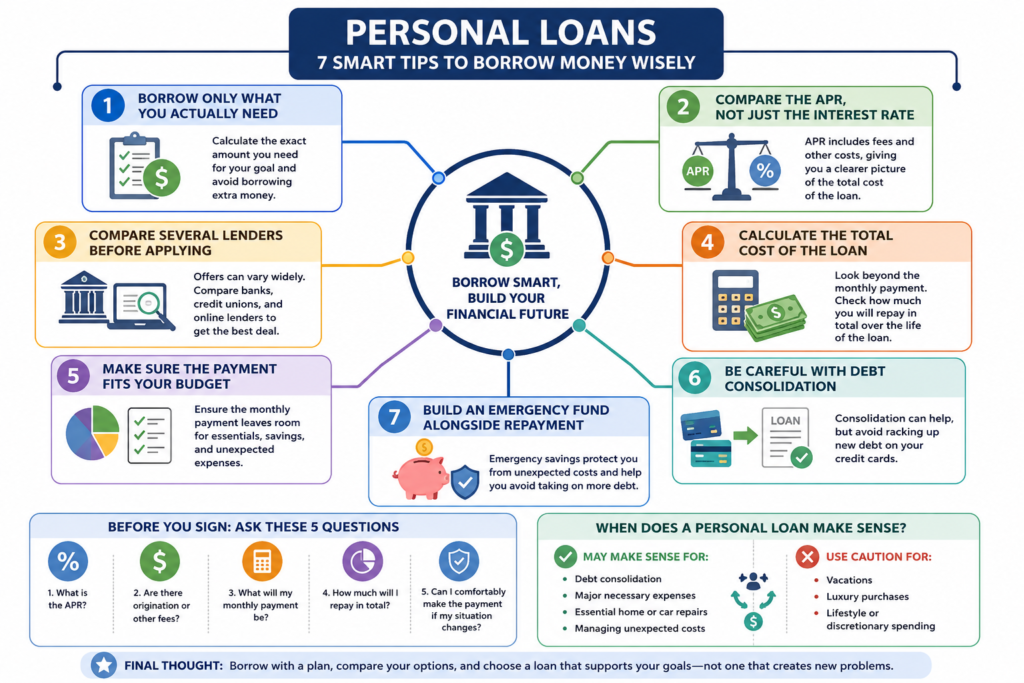
1. Borrow Only What You Actually Need
A lender may approve you for more money than you originally planned to borrow. That does not necessarily mean you should accept the full amount.
For example, if you need $6,000 but qualify for a $10,000 personal loan, borrowing the additional $4,000 means paying interest on money you may not actually need.
Before applying, calculate the exact amount required for your financial goal and try to stay close to that number.
2. Compare the APR, Not Just the Interest Rate
One of the most important numbers to check when comparing personal loans is the Annual Percentage Rate (APR).
The advertised interest rate does not always represent the total cost of borrowing. Depending on the lender and loan, additional fees may apply.
APR can provide a more useful basis for comparing offers because it reflects borrowing costs more broadly.
When comparing loans, consider:
- APR
- Origination fees
- Monthly payment
- Loan term
- Late-payment fees
- Prepayment conditions
- Total amount you will repay
A loan with a slightly lower monthly payment is not necessarily the cheapest option overall.
3. Compare Several Lenders Before Applying
Personal loan offers can vary considerably between lenders.
Banks, credit unions, online lenders, and other financial institutions may evaluate borrowers differently. The amount offered, APR, fees, repayment period, and eligibility requirements can therefore vary.
Comparing multiple offers could potentially save you a significant amount of money over the life of the loan.
When available, consider using prequalification tools that allow you to estimate potential terms before submitting a full application. Check the lender’s terms to understand whether the process affects your credit.
4. Calculate the Total Cost of the Loan
A common mistake is focusing exclusively on the monthly payment.
Imagine two loans:
Loan A: $10,000 with higher monthly payments over three years.
Loan B: $10,000 with lower monthly payments over five years.
Loan B may initially appear more affordable because the monthly payment is smaller. However, the longer repayment period can result in more interest being paid overall.
Before accepting a loan, ask yourself:
How much will I have paid in total when the final payment is made?
That number can be more informative than the monthly payment alone.
5. Make Sure the Payment Fits Your Budget
Before borrowing, test the future payment against your current monthly budget.
Start with your monthly take-home income and subtract essential expenses such as housing, food, utilities, transportation, insurance, existing debt payments, and regular savings.
Then consider whether the new loan payment leaves enough room for unexpected expenses.
A payment that technically fits your budget but leaves almost no financial cushion can create problems when an emergency occurs.
6. Be Careful When Using Personal Loans for Debt Consolidation
Debt consolidation is a common reason for taking out a personal loan.
For example, someone carrying balances on several high-interest credit cards might use one personal loan to pay them off and replace multiple payments with a single monthly payment.
This strategy can make sense when the new loan provides favorable terms and reduces borrowing costs.
However, consolidation does not solve the underlying problem if you immediately begin accumulating new credit card balances.
If you consolidate debt, consider creating a plan to avoid rebuilding the balances you just paid off.
7. Build an Emergency Fund Alongside Repayment
Once you begin repaying the loan, try to continue building some emergency savings when your budget allows.
Without savings, an unexpected car repair, medical bill, or temporary loss of income could force you to borrow again.
Even a modest emergency fund can provide an important financial buffer.
Over time, the goal should be to reduce your dependence on borrowed money for unexpected expenses.
When Does a Personal Loan Make Sense?
A personal loan may be worth considering when it helps you accomplish a specific financial objective and you have a realistic repayment plan.
Possible uses include consolidating expensive debt, covering a necessary major expense, financing an essential repair, or managing certain unexpected costs.
On the other hand, borrowing for discretionary spending deserves additional caution. Financing vacations, luxury purchases, or lifestyle expenses can mean continuing to pay for something long after the money has been spent.
Before You Sign: Ask These Five Questions
Before accepting a personal loan, make sure you can answer these questions:
- What is the APR?
- Are there origination or other fees?
- What will my monthly payment be?
- How much will I repay in total?
- Can I comfortably make the payment if my financial situation changes?
If any of these answers are unclear, take additional time to review the loan agreement before signing.
Final Thoughts
The best personal loan is not necessarily the one offering the largest amount or the smallest monthly payment.
A better loan is one that provides the money you genuinely need at a reasonable overall cost, with payments that fit comfortably within your budget.
Compare multiple offers, understand the APR and fees, calculate the total repayment amount, and borrow with a specific purpose.
Used carefully, a personal loan can be a useful financial tool. Used without a repayment strategy, it can become another long-term financial burden.
This article is for general educational purposes and does not constitute individualized financial advice.