
For many people new to investing, the idea of starting with just $100 can seem insignificant or even intimidating. The good news is that there is a government-backed, low-risk way to put that first $100 to work—by purchasing U.S. Treasury securities directly through TreasuryDirect. This guide will break down the essentials, focusing on why this route is accessible, what you need to know about getting started, and the risks and terms involved. If you want to learn by doing, a small, thoughtful first step can make a real difference for your financial confidence and understanding.
Why Build Emergency Savings First?
Before you invest any amount of money—including $100—it’s important to make sure you have an emergency fund in place. MyMoney.gov recommends setting aside at least three months’ worth of living expenses in a separate savings account. This ensures that unexpected events, like job loss or a health expense, don’t force you to sell investments at a loss or before they’ve had time to grow. Building this cushion is the foundation for any beginner investor—it protects both your finances and your peace of mind.
Sources: Save and Invest | MyMoney.gov.
Understanding Basic Investing Principles and Risks
It’s smart to understand some key investing concepts before putting your money to work. The U.S. Securities and Exchange Commission’s Investor.gov suggests always asking important questions: Is the investment product or platform registered? Do I clearly understand how it works? What are the risks as well as the possible rewards? For beginners, it’s helpful to learn about compound growth (how earnings can build upon previous earnings over time), time horizon (how long you plan to keep your money invested), and how diversification and asset allocation help manage risk. These basics build a good foundation—even with small amounts.
Sources: Five Questions to Ask Before You Invest | Investor.gov; Introduction to Investing | Investor.gov.
How to Use TreasuryDirect and Invest $100
TreasuryDirect is an official online platform run by the U.S. Department of the Treasury. It allows individuals to buy government securities directly without needing an outside broker. There is no account-opening fee. The only cost is the face value of the security you want to buy—no commissions, no management fees.
Most U.S. Treasury securities available on TreasuryDirect (such as Treasury bills and Treasury Inflation-Protected Securities, or TIPS) have a minimum investment of $100. Some savings bonds can be bought for as little as $25. The platform lets you choose from different government-backed options based on your goals and preferences.
Sources: TreasuryDirect — TreasuryDirect.
The Process: Opening, Funding, and Buying
To start, visit TreasuryDirect online and open an account using your personal and banking information. Once the account is set up, you can transfer funds from your bank. From there, you select the type of Treasury security you want, such as a bill or bond, and specify the amount—at least $100 for most types.
A key benefit for investors is that TreasuryDirect does not charge extra fees. You pay only for the Treasury security you purchase. There are no commissions or maintenance costs. After buying, you’ll be able to track your investment, view details about its maturity and interest payments, and manage your holdings—all online.
Sources: TreasuryDirect — TreasuryDirect.
Treat It as a Learning Opportunity
Investing $100 in a Treasury security is more than just growing your money—it’s a practical way to learn about how investments work. Doing this lets you get hands-on experience with an official government investing system, understand how securities mature, and watch how compound growth works over time.
Taking this first step with a small amount allows you to become comfortable with financial concepts, terms, and the process itself. Over time, this can build confidence and help you expand into other investment options, such as diversified products or retirement accounts—always at your own pace and after understanding the risks.
Sources: Five Questions to Ask Before You Invest | Investor.gov; Introduction to Investing | Investor.gov.
Risks, Limitations, and Disclaimers
This approach is not personalized advice—what works for one person may not be best for another. Treasury securities are extremely low-risk because they are backed by the U.S. government, but this safety can come with lower returns compared to more volatile investments like stocks. There can also be liquidity constraints; some securities have minimum holding periods, or early redemption penalties, especially on certain savings bonds.
It’s important to review up-to-date terms, rates, and conditions on TreasuryDirect each time you consider a purchase, because these factors can change and may affect your results, especially with very small investments.
Sources: TreasuryDirect — TreasuryDirect; Financial Tips for New Investors | FINRA.org.
Summary: Start Small, Learn by Doing
By building your emergency savings first, understanding basic principles of investing, and using an official, no-fee platform like TreasuryDirect, you can start your investment journey safely and come away smarter from the experience. Investing $100 directly in U.S. Treasury securities offers a low-barrier way to practice long-term thinking, reduce unnecessary fees, and build financial know-how for the future.
Always be cautious and double-check details on the TreasuryDirect website before making investment decisions.
Sources: TreasuryDirect — TreasuryDirect; Five Questions to Ask Before You Invest | Investor.gov; Introduction to Investing | Investor.gov; Save and Invest | MyMoney.gov.
Key takeaways
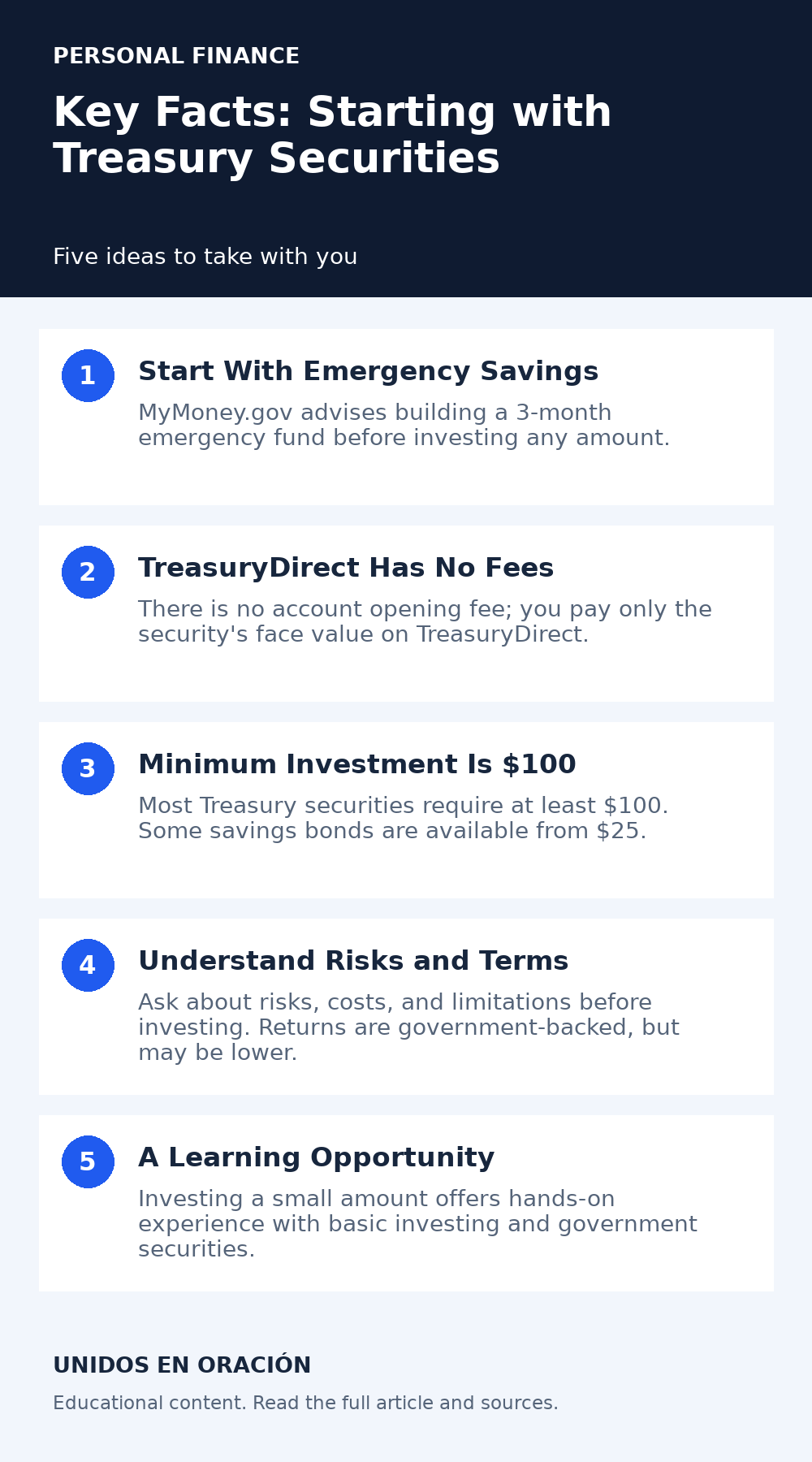
- Start With Emergency Savings: MyMoney.gov advises building a 3-month emergency fund before investing any amount.
- TreasuryDirect Has No Fees: There is no account opening fee; you pay only the security's face value on TreasuryDirect.
- Minimum Investment Is $100: Most Treasury securities require at least $100. Some savings bonds are available from $25.
- Understand Risks and Terms: Ask about risks, costs, and limitations before investing. Returns are government-backed, but may be lower.
- A Learning Opportunity: Investing a small amount offers hands-on experience with basic investing and government securities.
Putting it into practice
Starting small as a beginner investor is both reasonable and wise. Using $100 through TreasuryDirect lets you experience investing with the confidence of government backing and no hidden fees. Building on these basics will help prepare you for more advanced investing later. Remember to review official information frequently, keep safety in mind, and always have an emergency fund before you invest.
Sources and further reading
- TreasuryDirect — TreasuryDirect
- Five Questions to Ask Before You Invest | Investor.gov
- Introduction to Investing | Investor.gov
- Save and Invest | MyMoney.gov
- Financial Tips for New Investors | FINRA.org
Research date: September 11, 2026. Educational information, not personalized financial advice. Rules and product terms can change; confirm them with the provider. Prepared with AI assistance.