
Choosing your first trading platform can be confusing. There are dozens of brokers offering mobile apps, low brokerage fees, investment tools and access to different financial products.
For beginners, however, the best trading platform is not necessarily the platform with the largest number of features. A good beginner platform should be easy to understand, reasonably priced, properly regulated and suitable for the type of investing or trading you actually want to do.
In this guide, we’ll look at some of the most important things beginners should consider when comparing trading platforms in India.

What Is a Trading Platform?
A trading platform is an app or website that allows you to buy and sell financial securities through a broker.
In India, investors generally need three things to start investing in the securities market:
- A bank account
- A trading account
- A Demat account
The trading account is used to place transactions, while the Demat account holds securities electronically.
Your broker connects you with the stock exchange and provides the platform you use to manage your investments.
Best Trading Platforms for Beginners
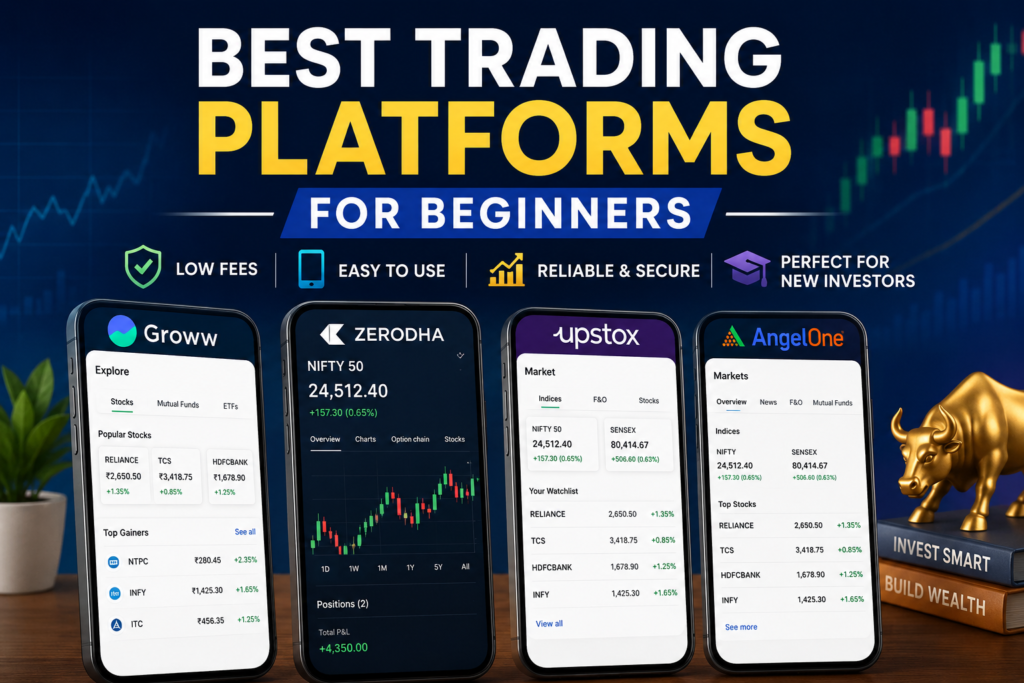
Several large platforms compete for Indian retail investors. Among the names beginners are likely to encounter are Groww, Zerodha, Upstox and Angel One.
There is no single platform that is best for everyone. Each has different strengths.
1. Groww — Best for Simplicity
Groww has become particularly popular among newer investors because of its mobile-first approach and relatively simple interface.
For someone who has never invested before, simplicity matters. A beginner may initially want to buy stocks or mutual funds without navigating professional trading screens containing dozens of indicators.
Best suited for:
- First-time investors
- Mobile users
- Mutual fund investors
- Investors who prefer a simple interface
The trade-off is that investors should still examine brokerage and transaction-related charges rather than assuming that a simple platform is automatically the cheapest.
2. Zerodha — Best for Growing With Your Experience
Zerodha is one of India’s best-known discount brokers.
Its Kite trading platform provides a relatively clean interface while offering considerably more functionality for investors who eventually want advanced charts and trading tools.
This makes Zerodha interesting for beginners who expect their needs to become more sophisticated over time.
Best suited for:
- Long-term stock investors
- Beginners who want room to progress
- More active traders
- Investors interested in advanced trading tools
Its pricing structure differs from competitors, so investors should compare annual maintenance and transaction-related charges based on how frequently they expect to trade.
3. Upstox — Good All-Round Trading Platform
Upstox combines mobile investing with tools designed for people who eventually want to become more active market participants.
It can therefore sit somewhere between extremely simple investment apps and more specialized trading platforms.
Best suited for:
- New investors
- Mobile traders
- Investors who may eventually trade more actively
- Users looking for an all-purpose platform
As with any broker, beginners should compare the complete fee structure rather than brokerage alone.
4. Angel One — Good for Research and Market Information
Angel One combines brokerage services with research and investment information.
That can appeal to beginners who want more information available within the same ecosystem instead of simply having an interface for placing orders.
Best suited for:
- Beginners interested in market research
- Stock investors
- Users looking for investment information and trading in one platform
- Investors who want access to multiple market products
More information is not necessarily better for every beginner, however. Someone who simply wants to make occasional long-term investments may prefer a simpler platform.
Quick Comparison
| Platform | Particularly Suitable For |
|---|---|
| Groww | Simplicity and first-time investors |
| Zerodha | Long-term investors and users who want advanced tools later |
| Upstox | General investing and trading |
| Angel One | Research-oriented investors |
The right choice depends much more on your intended use than on which app is the most popular.
What Should Beginners Compare?
Before opening an account, compare these six factors.
1. Regulation
This should come before features or brokerage fees.
A broker operating in India’s securities market should have the appropriate registration. Investors can verify registered intermediaries through the Securities and Exchange Board of India (SEBI).
Never deposit money simply because a trading app looks professional or because someone recommends it on social media.
2. Brokerage Fees
Brokerage is the amount charged for executing certain transactions.
Many discount brokers advertise very low or zero brokerage for particular types of transactions.
However, «zero brokerage» does not necessarily mean that investing is completely free.
3. Other Account Charges
Look beyond the headline brokerage rate.
Depending on the broker and activity, costs can potentially include:
- Account maintenance charges
- Depository participant (DP) charges
- Exchange-related charges
- Taxes
- Margin interest
- Pledging charges
- Other transaction fees
This is why comparing brokers based exclusively on a ₹0 or ₹20 headline brokerage rate can be misleading.
4. Ease of Use
Beginners should be able to answer basic questions immediately:
How much money is available?
What investments do I own?
How much am I buying?
What type of order am I placing?
What fees could apply?
If you cannot understand what an order will do before pressing the buy or sell button, the platform may be unnecessarily complicated for your current experience level.
5. Investment Options
Decide what you actually want to invest in.
You may be interested in:
- Indian stocks
- ETFs
- Mutual funds
- IPOs
- Bonds
- Commodities
- Futures and options
Not every beginner needs access to every product.
In fact, access to sophisticated instruments should not be confused with a better beginner experience.
6. Customer Support
Customer support becomes especially important when dealing with money.
Before choosing a broker, investigate how users can contact support and how complaints are handled.
Groww vs Zerodha for Beginners
This is likely to be one of the most common comparisons for someone entering the Indian market.
A simplified way of thinking about the difference is:
Groww → simplicity first
Zerodha → investing/trading ecosystem first
A person primarily interested in a straightforward mobile investing experience may find Groww attractive.
Someone who expects to eventually use more sophisticated market tools may prefer Zerodha.
Fees can also change the calculation.
For example, current published comparisons show meaningful differences between the two in equity delivery brokerage, annual maintenance charges and other transaction costs.
Therefore, the cheapest option depends partly on how you invest.
Trading vs Investing: Beginners Should Know the Difference
Before choosing a platform, determine whether you actually want to trade or invest.
Investing generally involves buying assets with the intention of holding them for longer periods.
Trading generally involves buying and selling more frequently in an attempt to profit from shorter-term price movements.
A platform optimized for active trading may emphasize charts, indicators, derivatives and rapid execution.
A platform optimized for long-term investors may emphasize portfolios, mutual funds, ETFs and simplicity.
Neither approach makes a platform universally better.
Should Beginners Use Futures and Options?
Beginners should be especially careful with leveraged and derivative products.
Futures and options are substantially more complex than simply purchasing shares, and losses can occur rapidly.
The fact that a broker makes these products accessible through a simple mobile interface does not make the underlying financial risk simple.
Learn how the product works before putting money into it.
How to Choose Your First Broker
A beginner can use a simple process:
Step 1: Decide whether your primary objective is long-term investing or active trading.
Step 2: Verify that the broker is appropriately registered.
Step 3: Determine which investments you need access to.
Step 4: Compare brokerage and total account costs.
Step 5: Compare the mobile and web platforms.
Step 6: Investigate deposits, withdrawals and customer support.
Step 7: Start with an amount of money you can afford to expose to market risk.
Which Trading Platform Is Best for Beginners?
There isn’t one universal winner.
For a beginner prioritizing simplicity, Groww can be an attractive option.
For someone wanting a platform that can accommodate increasingly sophisticated investing and trading needs, Zerodha deserves consideration.
Upstox provides another broad alternative, while Angel One may appeal to investors who value integrated research and market information.
The most important point is not to choose a broker because an advertisement promises easy trading, low fees or fast profits.
Compare regulation, total costs, investment products, platform usability and support.
Your first trading platform should make investing easier to understand — not encourage you to take risks you don’t understand.
Disclaimer: This article is for educational and informational purposes only and does not constitute investment or financial advice. Brokerage fees, features and account conditions can change. Always verify current information directly with the broker and relevant financial regulator before opening or funding an account.